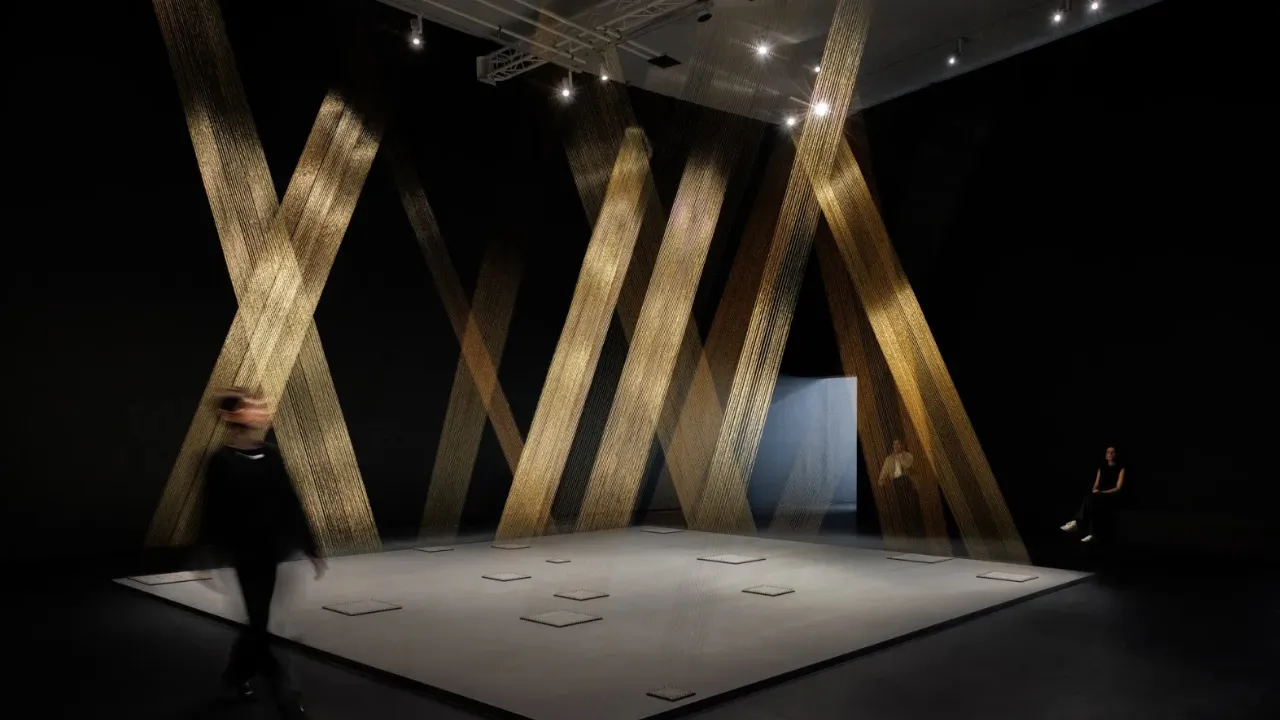
Lygia Pape (1927–2004) was a pioneering Brazilian artist whose practice encompassed painting, sculpture, engraving, film, performance, and installation. A central figure of the Neo-Concrete Movement in Brazil during the late 1950s, together with Lygia Clark and Hélio Oiticica, Pape sought to free geometric abstraction from its formal rigidity and infuse it with sensorial, participatory, and poetic dimensions. Her work blurred the boundaries between art and life, engaging with perception, temporality, and the body’s relationship to space. Educated at the Museum of Modern Art in Rio de Janeiro, she developed an artistic language that merged European modernist ideas with Brazilian cultural and indigenous sensibilities. During the 1960s and 1970s, her experimental films and conceptual works responded to the political realities of Brazil’s military dictatorship. Later, in her iconic Ttéia series (from 1978), she transformed minimalist structures into luminous, immersive environments of light and geometry, embodying both material precision and transcendental spirituality. At the Pinault Collection, Bourse de Commerce (Paris, 2025), Pape’s exhibition presents a rare and comprehensive selection of her works, tracing her lifelong exploration of perception, participation, and form. The exhibition highlights the transition from her early woodcuts and geometric abstractions to her sensorial and environmental installations, offering a poetic reflection on space, structure, and the shared experience of art. Within the Pinault Collection’s architecture, her works resonate as living systems of light and energy — a dialogue between modernist rigor and the human desire for connection and transformation.
WEAVING SPACE , Lygia Pape (1927-2004), Pinault Collection, Bourse de Commerce (Paris, 2025)
Lygia Pape (1927–2004) was a pioneering Brazilian artist whose practice encompassed painting, sculpture, engraving, film, performance, and installation. A central figure of the Neo-Concrete Movement in Brazil during the late 1950s, together with Lygia Clark and Hélio Oiticica, Pape sought to free geometric abstraction from its formal rigidity and infuse it with sensorial, participatory, and…