

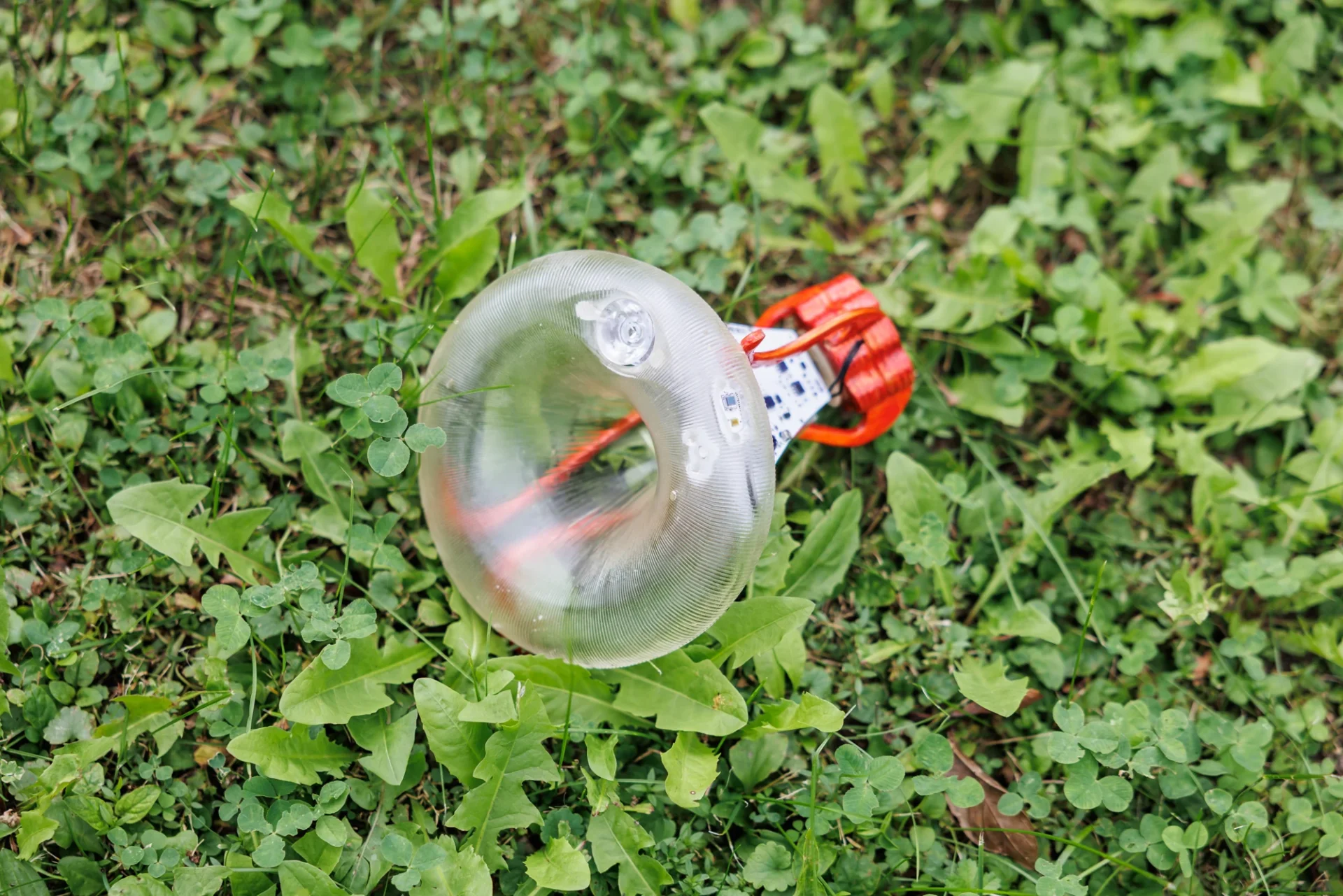
Scattered among plants, small translucent horn-shaped sculptures respond to changes in light and to the signals around them. In Komorebi, each unit acts locally: space, foliage and weather transform the exchanges within this electronic swarm. The visitor moves through a sonic environment rather than listening to a central source. Where does life begin when a sculpture becomes sensitive to the conditions around it?
Location: Garden of the Imperceptible, Dutch Pavilion at the 16th Gwangju Biennale, Missionary Wilson’s House, Gwangju, South Korea, September 5–November 15, 2026. The work was also presented at Ars Electronica, Sisters of St. Elizabeth / Sonnenhof, Linz, Austria, September 9–13, 2026. The photograph documents Linz; the video is earlier documentation published by iii on October 29, 2021. The pavilion’s September 21, 2026 post shows this same sculpture.
Artists: Cofounders of the artist-run platform iii, Matteo Holyoke Marangoni and Dieter Vandoren work in the Netherlands. Italian-born, Hague-based Marangoni combines robotics, sound and ecological perception; Belgian-born Vandoren develops spatial audiovisual environments and interactive architectures.
Sources: Matteo Marangoni; iii; Dutch Pavilion, September 21, 2026; Ars Electronica 2026.